
Advisory Note: The Gap
Paleolithic Nervous Systems, Artificial Intelligence

I turned 80 this year.
That means I’ve watched enough transitions to know the pattern. Something new arrives. It promises everything. People divide into the frightened and the evangelists. And somewhere in the middle, quietly, the real question gets lost.
The real question right now isn’t about the tools.
It’s about us.
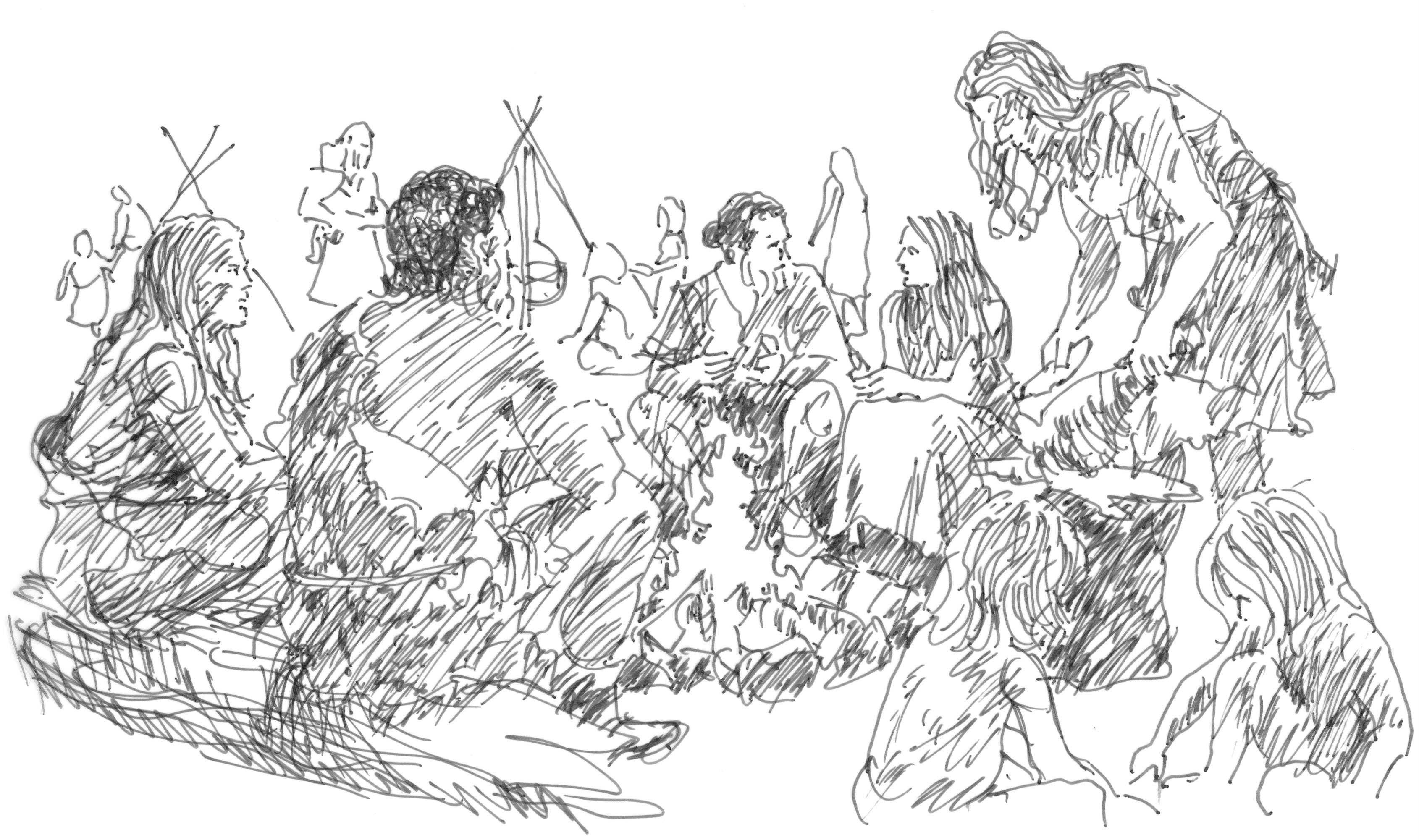
There are eight billion of us on this planet. For three hundred thousand years, we evolved in groups small enough to know every face at the fire. Anthropologists call it Dunbar’s number — roughly 150 people. Within that circle, we could track loyalty, reputation, threat, and care. We knew who was reliable and who wasn’t. We knew when someone had gone quiet and why it mattered.
Beyond that scale, our nervous systems strain.
We default to tribe. We hoard. We other. We form camps.
Our technology has become planetary. Our emotional wiring has not.
This gap — between Paleolithic emotion and god-like tools — may be the real test of this era. Not whether AI is safe. Not whether it takes our jobs. Whether we are capable of the cooperation this moment actually requires.
I don’t know the answer to that at civilizational scale. No one does.
But I work at a different scale. I work with creative firms of twenty to eighty people. And what I’ve come to believe — after decades of this work — is that the small group is not a consolation prize. It is, in fact, the unit of human organization that evolution actually built us for.
Inside a firm that size, led well, the Dunbar conditions still hold. People know each other. Reputation means something. When someone goes quiet, someone else notices. Trust isn’t a value statement on a website. It’s a daily practice, visible and fragile and real.
These firms can adapt to AI faster than the giants. Not because they have better tools or more brains. Because they have something the giants have almost entirely lost — the ability to feel what’s happening inside the room and respond to it.
Entire professions will dissolve and recombine. Knowledge will be cheap. Capability will expand in ways I can’t see. Maybe you can’t either.
And the cooperation required to navigate this moment may be greater than any we’ve ever asked of ourselves.
I think it will be won or lost in rooms small enough that people can still read each other’s faces. In firms where a leader pays close enough attention to notice when someone has gone quiet. In groups that hold together not because they have to, but because they’ve built something worth protecting.
That advantage, measured against the scale of what’s coming.
Is everything.
Congrats on reaching 80.